An AI budget cap is an execution control that refuses additional work when admitting that work would exceed a defined spending limit. A budget alert reports that a threshold has been reached; refusal requires a connection between the budget account and the system that starts the work.
Accounting before execution
A cap needs a unit, an owner and an accounting period. A limit of $500 per case differs from $500 per team per day. The same request can fit inside one limit and exceed another.
For a hard cap on variable request charges, admission must account for both completed work and work already accepted. Waiting for a provider invoice leaves accepted but unbilled work outside the decision.
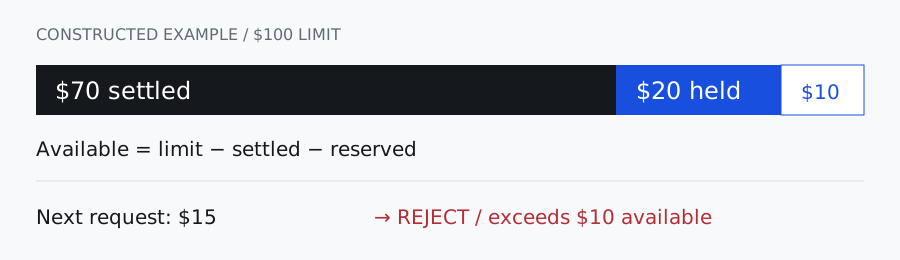
One design reserves the maximum permitted cost of a request before starting it. Available budget equals the limit minus settled charges and outstanding reservations. Completion converts the reservation into the actual charge and releases the unused amount. This design requires an enforceable upper bound on each admitted request’s cost; an estimate alone does not provide a hard guarantee.
Take a $100 limit, $70 in settled charges and $20 reserved for running work. Available budget is $10. A request requiring a $15 reservation is rejected even though the settled bill is still $30 below the limit.
Concurrent requests share one allowance
Separate workers cannot each treat the same remaining balance as their own. With $10 available, two workers that independently approve $8 requests commit $16. The limit is exceeded before either request finishes.
The reservation therefore needs a coordinated update or separately assigned allowances whose sum stays within the remaining budget. Retries and delegated work must consume the relevant allowance as well. Creating another agent does not create more money in the parent budget.
Resource quotas provide a concrete admission-control example. Kubernetes rejects resource creation or update requests that would violate a namespace quota. The bounded quantities are resources such as requested CPU and memory, not an accumulated cloud invoice. Kubernetes Resource Quotas.
The enforcement boundary determines the guarantee
A cap enforced at a gateway covers work routed through that gateway. A worker with credentials to call the provider directly has a separate route to incur charges. The spending boundary is complete only when every chargeable action within the claimed scope passes an enforcement point or consumes a preassigned allowance.
A concurrency limit answers a different question: how much work runs at once. A rate limit bounds how much starts within an interval. Neither yields a monetary ceiling without prices, duration and the rest of the charging model.
Budget exhaustion is a service state
Exhaustion requires a defined outcome: reject new work, queue it for a later budget period, or request additional authorization. Each outcome changes what happens to the case waiting for service. Silently retrying a rejected operation turns an exhausted allowance into repeated failed work.
Stopping admissions also leaves already accepted work to finish, cancel or expire. Storage and committed infrastructure remain separate costs unless the cap explicitly controls them. The precise claim is a bound on specified expenditure through specified execution paths, with an explicit treatment of work in progress.