AI cost per decision is the cost assigned to an AI-assisted process divided by the number of decisions that meet a stated counting rule. The counting rule identifies the stage completed, the cases included and the period measured.
A model request counts a technical operation. An eligibility assessment resolves one question within a case. A final decision completes the decision process. These units remain distinct even when one system contributes to all three.
Matching costs to completed work
A unit cost requires a numerator and denominator with the same boundary. Cost per eligibility assessment includes the costs assigned to eligibility assessment. Cost per completed case includes the work required to reach case completion, including human handling after an automated assessment.
For a group of completed cases, the calculation is the cost assigned to that group divided by its case count. Requests repeated within one case add to the numerator without adding another completed case. Counting those requests as separate decisions changes the unit being measured.
Costs incurred during a month divided by cases completed during that month produce a period measure. That figure differs from the cost of the completed cases when spending also covers cases still in progress. Changes in the backlog therefore affect the relationship between monthly spending and completed-case cost.
Case mix changes the average
Case mix is the composition of a workload by characteristics that affect the work required. When automation selects routine cases, the automated group and the remaining group have different case mixes. Their average costs describe different workloads.
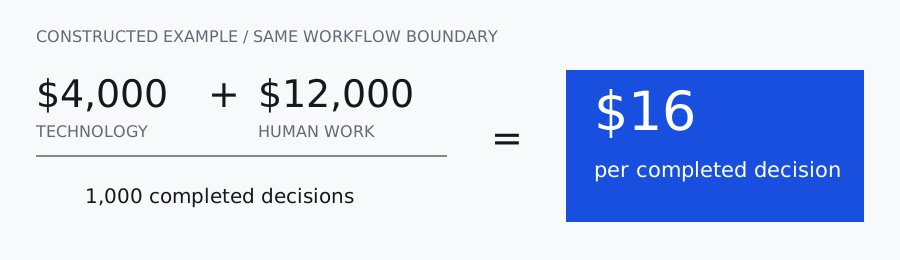
Take 1,000 completed cases. Assign $4,000 to technology used across the process, $3,000 to human work on 800 routine cases and $9,000 to human work on 200 other cases. The process costs $16,000, or $16 per completed case. Technology spending divided by the 800 routine cases is $5. That calculation measures technology spending per routine case, even though the technology also serves the other cases. It does not measure the cost of completing a case.
The 200 other cases account for 75% of human handling costs in this calculation. Reporting only the routine group removes most human handling expenditure from view. Reporting only the remaining group’s average also fails to describe the whole service.
An automated assessment is not a completed case
Canada’s in-country spouse or common-law partner sponsorship process illustrates the distinction. In material prepared for a December 5, 2023 committee appearance, Immigration, Refugees and Citizenship Canada described a tool deployed in April 2021 that approved eligibility for some routine applications. Officers still assessed admissibility and made every final application decision. Applications without automated eligibility approval received an individual officer assessment. IRCC’s December 2023 account.
For that process, counting automated eligibility approvals as completed applications would place the denominator at the wrong stage. The automated output leaves further work inside the service boundary. A calculation based only on producing that output cannot establish the cost of completing the application.
Comparing AI-assisted and previous processes
A cost comparison holds the service boundary and counting rule fixed. When case mix differs, the comparison separates case groups or adjusts for their composition. A routine-case automation figure and a whole-service manual figure cannot establish savings through direct subtraction.
Total process cost and additional cost answer different questions. Total process cost includes the resources assigned to operating the service. Additional cost measures the change against a specified alternative, including increases or reductions in human effort. Charging all existing staff effort as new AI expenditure overstates the additional cost; excluding staff effort from a total-process measure understates that total.
Cost per successful decision adds an outcome criterion to the denominator. The criterion must specify what counts as success and when it is assessed. A decision counted at issue and a decision counted after a defined review period belong to different measures. A lower reported unit cost establishes a cheaper outcome only when the cost boundary, case mix and outcome criterion support that comparison.