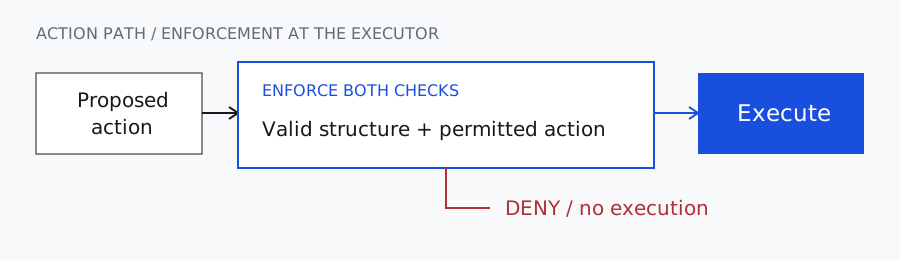
Human oversight of an AI system is a process in which people inspect its operation or outputs and can change what happens next. Its preventive effect depends on whether intervention reaches the relevant action before that action takes effect.
The presence of a named reviewer establishes responsibility. Effective oversight also needs information, decision authority and a working connection to execution.
Approval before action
An approval gate suspends a specified action until an authorized person accepts, changes or rejects it. The gate must identify the target, arguments and consequences of the proposal. Approving a general intention is not the same decision as approving a particular operation on a particular record.
A workflow can implement this suspension explicitly. LangGraph interrupts pause execution and resume it with supplied input. That mechanism establishes a waiting point; the application determines which action waits and how the response controls it. LangGraph interrupts.
The approved proposal must remain bound to the executed action. If a recipient or amount changes after approval, the earlier decision does not authorize the revised operation. The same applies when circumstances relevant to permission change while the proposal is waiting.
Monitoring during execution
Monitoring permits work to proceed while an operator observes it. Intervention can stop later work without undoing what has already happened. A stop button that prevents the next message does not retrieve a message already delivered.
Take an action that releases information 10 seconds after a triggering event. Detection takes 4 seconds, human assessment takes 8 seconds and enforcement takes 2 seconds. The response arrives after 14 seconds. It is too late to prevent that release, even though every part of the oversight process functioned as designed.
Introducing a genuine hold before release changes the mechanism. Shortening a dashboard refresh interval changes only one component of the delay. The relevant measure is event-to-effective-intervention time, including confirmation that the action was stopped.
Review capacity limits the process
Take 300 proposals per hour and three minutes of review for each. They require 900 reviewer-minutes, or 15 reviewer-hours, per hour of arrivals. A team of five reviewers has one-third of that nominal capacity before breaks, administration or complex cases are considered.
A mandatory gate with that staffing accumulates a queue. An automatic approval after a timeout removes the hold from overdue proposals. These arrangements provide different controls and different service performance; neither can be described accurately by the reviewer count alone.
Testing judgment as well as access
A reviewer who can reject a proposal still has to recognize the error. In a 2021 experiment, Buçinca, Malaya and Gajos compared designs intended to prompt more deliberate consideration with explanation interfaces and a no-AI baseline. The comparison treated the design of human review as a variable to test. To Trust or to Think.
An operational test can similarly insert known incorrect recommendations and measure detection, correction and response time. Approval rate alone cannot separate careful acceptance of correct proposals from uncritical acceptance of everything. Testing also has to confirm that rejection changes execution.
Oversight therefore has two distinct results: a human judgment and its effect on the system. A record of the first does not establish the second.